Category: Digital Marketing

  • 10 Google Ads Mistakes That Waste Your Advertising Budget

    10 Google Ads Mistakes That Waste Your Advertising Budget

    Google Ads can be one of the most effective ways to generate leads for an Australian business — but only when it’s set up and managed correctly. Too often, business owners launch a campaign, watch the budget disappear within days, and walk away convinced that “Google Ads just doesn’t work” for their industry.

    In most cases, the platform isn’t the problem. The setup is.

    Small, easy-to-miss mistakes compound quickly in a pay-per-click environment. A poorly chosen keyword match type, a missing negative keyword list, or a landing page that doesn’t match the ad can quietly drain hundreds or thousands of dollars a month without ever showing up as an obvious red flag. Below are the ten most common — and most costly — Google Ads mistakes we see, along with what to do instead.

    1. Using Broad Match Keywords Without Guardrails

    Broad match is designed to show your ad for searches Google considers related to your keyword — not just the keyword itself. Left unchecked, this can mean your ad for “kitchen renovations Melbourne” starts showing up for searches like “kitchen renovation shows on TV” or “cheap kitchen appliances,” neither of which will ever convert into a customer.

    Broad match isn’t inherently bad — Google’s algorithm has genuinely improved at matching intent over the years — but it needs guardrails: strong negative keyword lists, tight audience signals, and close monitoring of the search terms report. Running broad match with no oversight is one of the fastest ways to burn through a daily budget on irrelevant clicks.

    Fix it: Start new campaigns with phrase match or exact match to control exactly which searches trigger your ads. Once you have solid conversion data, test broad match carefully, and check the search terms report weekly.

    2. Ignoring the Search Terms Report

    The search terms report shows the actual words and phrases people typed before your ad appeared and they clicked. It is arguably the single most valuable piece of data in the entire account, and it’s astonishing how many campaigns run for months without anyone looking at it.

    This report reveals exactly where wasted spend is hiding — irrelevant searches, junk traffic, or completely unrelated queries that broad or phrase match keywords accidentally triggered.

    Fix it: Review the search terms report at least weekly for new accounts and monthly for mature ones. Add irrelevant terms as negative keywords immediately, and look for new keyword opportunities hiding in there too — sometimes customers search in phrases you hadn’t thought to target.

    3. Skipping Negative Keywords Entirely

    Negative keywords tell Google which searches you don’t want your ad to appear for. Without them, you’re often paying for clicks that were never going to convert — job seekers searching “plumbing apprenticeship,” DIY researchers searching “how to fix a tap myself,” or bargain hunters searching “free” anything.

    A mortgage broker who doesn’t exclude “government grants” or “centrelink” searches, or a law firm that doesn’t exclude “free legal advice,” can lose a significant share of their budget to clicks that were never real leads.

    Fix it: Build a negative keyword list before launch based on obvious irrelevant terms (jobs, free, DIY, cheap, courses), then keep refining it every week using the search terms report. Apply negative keyword lists at the account or campaign level so they apply consistently across every ad group.

    4. Sending Traffic to the Homepage Instead of a Landing Page

    This is one of the most common — and most expensive — mistakes. A visitor clicks an ad for “emergency electrician Brisbane” and lands on a generic homepage with a slider, five service categories, and no clear call to action. Confused, they leave. Google charged you for that click either way.

    Relevance between your ad and your landing page directly affects both your conversion rate and your Quality Score, which in turn affects how much you pay per click. A mismatch between what someone searched for and what they land on is a lose-lose: fewer conversions and higher costs.

    Fix it: Build (or request) a dedicated landing page for each major service or campaign, with a headline that mirrors the ad and search intent, a single clear call to action, and no unnecessary navigation distractions pulling visitors away before they enquire.

    5. Not Tracking Conversions Properly

    If your account can’t tell you exactly how many calls, form submissions, or bookings came from Google Ads, you’re optimising blind. Yet a surprising number of accounts have conversion tracking that’s broken, duplicated, counting the wrong actions, or not set up at all.

    Without accurate tracking, Google’s own bidding algorithms — which rely heavily on conversion data to optimise — are working with bad information. This often leads to overspending on keywords or audiences that Google thinks are performing well but actually aren’t.

    Fix it: Set up conversion tracking for every meaningful action — form fills, phone calls (including calls from the website, not just the ad extension), bookings, and, where relevant, offline conversions from your CRM. Test each conversion action to confirm it’s firing correctly before trusting the data.

    6. Targeting Too Broad a Geographic Area

    Location targeting is one of the simplest levers in Google Ads, and one of the most frequently mismanaged. Businesses that only service a 20km radius sometimes run campaigns targeting entire states or even the whole country, either by default settings or a lack of attention during setup.

    Even more subtly, Google’s location targeting setting has an option to show ads to “people in, interested in, or who’ve searched for” your target location — meaning someone searching Sydney suburbs from overseas could trigger your ad, even if you only service local customers.

    Fix it: Set location targeting to “Presence: People in or regularly in your targeted locations” for local service businesses, and define the exact suburbs, radius, or regions you actually service. Review the locations report periodically to confirm spend is concentrated where your customers actually are.

    7. Letting Ad Schedules Run 24/7 With No Adjustment

    Unless you have staff answering calls and enquiries around the clock, running ads at 2am with the same bids as your peak business hours is a quiet budget leak. Late-night or off-hours clicks can still cost the same as prime-time clicks, but with a much lower chance of ever converting into an actual booking or sale.

    Fix it: Review performance by hour of day and day of week (available in the account under ad schedule reporting), and adjust bids or scheduling accordingly. If your business only operates Monday to Friday, 8am to 5pm, there’s rarely a strong case for spending full budget on Saturday 1am searches.

    8. Set-and-Forget Campaign Management

    Google Ads is not a “set it up once and let it run” platform. Auction dynamics shift, competitors launch new campaigns, seasonal demand changes, and ad fatigue sets in over time. An account that hasn’t been touched in three months is almost always underperforming compared to where it could be.

    This mistake is especially common with businesses that hire an agency or freelancer, get an initial setup, and then never receive ongoing optimisation, reporting, or strategy adjustments.

    Fix it: Build in a regular review cadence — weekly checks on spend and search terms, monthly reviews of ad performance and Quality Score, and quarterly strategy reviews to reassess campaign structure, budgets, and goals as the business evolves.

    9. Using the Same Generic Ad Copy for Everyone

    Generic ad copy — “Quality Service. Call Today. Free Quotes.” — technically works, in that it will get impressions and some clicks. But it does nothing to differentiate your business from the five other ads sitting in the same auction, and it doesn’t speak to the specific intent behind different searches.

    Someone searching “same day carpet cleaning” has a different need than someone searching “carpet cleaning cost Melbourne,” yet many accounts show both searchers an identical ad.

    Fix it: Write ad copy tailored to specific keyword themes and search intent. Highlight what actually differentiates the business — response time, guarantees, local reputation, specific services — rather than generic claims every competitor also makes. Test multiple headlines and descriptions within each ad group and let the data show which resonates.

    10. Focusing on Clicks and Impressions Instead of Cost Per Lead and ROI

    It’s easy to get distracted by vanity metrics — impressions, click-through rate, even total clicks — without connecting them back to what actually matters: how many of those clicks turned into real leads, and how many of those leads turned into paying customers.

    A campaign with a low cost per click but a poor conversion rate can end up far more expensive, per actual customer, than a campaign with a higher cost per click but strong conversion performance. Businesses that only monitor surface-level metrics often keep funding underperforming campaigns simply because the numbers “look” fine on the surface.

    Fix it: Build reporting around cost per lead, lead-to-sale conversion rate, and return on ad spend rather than clicks or impressions alone. Where possible, connect Google Ads data to your CRM or sales records so you can see which campaigns and keywords are actually generating revenue, not just traffic.

    Bringing It All Together

    Individually, each of these mistakes might only cost a business a few hundred dollars a month. Combined — broad, unchecked keywords; no negative keyword list; generic landing pages; broken tracking; no geographic refinement; static schedules; a set-and-forget approach; generic ad copy; and a focus on the wrong metrics — they can add up to a campaign that quietly burns through most of its budget without ever delivering a reasonable return.

    The good news is that none of these issues are difficult to fix once identified. Most come down to attention and process rather than any deep technical complexity: reviewing the right reports regularly, keeping ad copy and landing pages aligned with search intent, and measuring success by leads and revenue rather than clicks alone.

    If you manage your own Google Ads account, working through this list is a useful audit in itself — pull up your search terms report, check your negative keyword list, and look at where your ads are actually spending money this month. If you’re not sure where to start, or simply don’t have the time to stay on top of it, that ongoing management is exactly the kind of work a dedicated Google Ads management service is built to handle — catching these issues before they quietly eat into the budget, rather than after.
  • Google Ads vs Meta Ads: Which One Generates Better Leads?

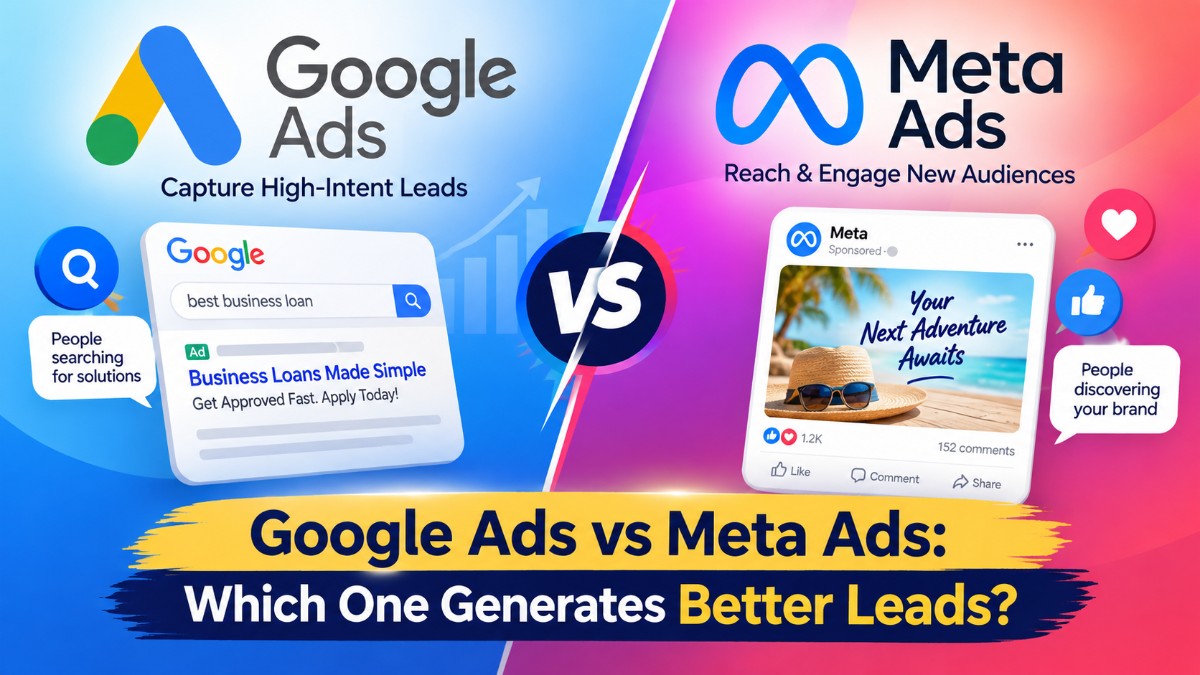
    Google Ads vs Meta Ads: Which One Generates Better Leads?

    Every business owner running paid advertising eventually asks the same question: should the budget go to Google Ads, Meta Ads, or both? It’s one of the most common debates in digital marketing, and the honest answer is that there isn’t a universal winner. The right platform depends on what you’re selling, how your customers search for it, and what “a good lead” actually looks like for your business.

    This article breaks down how each platform generates leads, where each one tends to outperform the other, and how to decide which is the smarter starting point for your budget — especially if you’re a business in Australia weighing up where to spend your first advertising dollars.

    Understanding the Core Difference: Intent vs Interruption

    The most important distinction between Google Ads and Meta Ads isn’t cost or targeting options — it’s intent.

    Google Ads works on search intent. Someone types “emergency plumber Parramatta” or “best car insurance Australia” into Google because they already have a need and are actively looking for a solution right now. Your ad shows up at the exact moment they’re ready to act. This is why Google Ads is often described as capturing demand rather than creating it.

    Meta Ads (Facebook and Instagram) works differently. It’s an interruption-based platform. People aren’t searching for anything — they’re scrolling through photos of friends, reels, or news. Your ad has to stop them mid-scroll and create interest in something they weren’t necessarily thinking about. This is why Meta Ads is often described as generating demand rather than capturing it.

    Neither approach is better in the abstract. But this single difference explains almost everything else about how leads behave on each platform — their volume, their cost, their quality, and how ready they are to buy.

    Lead Quality: Warm Intent vs Broader Reach

    Because Google Ads leads come from active searches, they tend to arrive further along in the buying journey. Someone searching “solar panel installation quote Brisbane” already knows they want solar panels — they just need to choose a provider. That makes Google leads, on average, warmer and more sales-ready.

    Meta Ads leads can be excellent too, but they usually sit earlier in the decision process. Someone who clicks a Facebook ad for solar panels might be mildly curious rather than ready to book an installation. This doesn’t make the lead worthless — it means your follow-up process needs to do more of the convincing, since the ad interrupted them rather than answered an existing need.

    For industries with high-intent, high-value searches — home services, legal, medical, finance, real estate — Google Ads often produces leads that convert to sales faster and at a higher rate. For industries that rely on visual appeal, impulse decisions, or building awareness before a purchase — fashion, beauty, home décor, hospitality, consumer products — Meta Ads frequently wins on both volume and cost-effectiveness.

    Cost Per Lead: It’s Not a Simple Comparison

    A lot of businesses compare Google and Meta purely on cost per lead, but this comparison misses the point unless you also account for lead quality and sales conversion.

    Google Ads costs per click are generally higher, particularly in competitive industries like legal services, insurance, or finance, where cost per click can run into double digits. But because the person is already searching with intent, the percentage of leads that go on to become paying customers is usually higher. A more expensive lead that converts is often cheaper, in the end, than a cheap lead that goes nowhere.

    Meta Ads typically produce a lower cost per click and can generate a higher volume of leads for the same budget. However, because the audience wasn’t actively searching, a larger share of those leads may not be ready to buy immediately, or may not be a strong fit at all. This means the real cost per qualified lead can end up closer to Google’s than the initial cost per click suggests.

    The only reliable way to know which platform is cheaper for your business is to track cost per qualified lead and cost per sale — not just cost per click or cost per form fill.

    Speed to Results

    Google Ads can start generating leads almost immediately once campaigns are live, assuming your keywords, ad copy, and landing page are aligned with what people are searching for. There’s little need for the algorithm to “learn” who your customer is — the searcher has already told you their intent through the keyword they typed.

    Meta Ads usually need a learning phase. The algorithm needs time and data (generally a minimum ad spend and a set number of conversions) to figure out who responds well to your ad and refine targeting accordingly. This means Meta campaigns often improve meaningfully after the first one to two weeks, as the system optimises delivery.

    If you need leads urgently — for example, filling appointment slots this week — Google Ads is usually the faster lever to pull. If you’re building a longer-term customer acquisition engine and can allow a short optimisation window, Meta Ads can become highly efficient once it settles.

    Targeting: Keywords vs Audiences

    Google Ads targets based on what people type. This makes it extremely effective for capturing existing, specific demand — but only if that demand is being expressed through search in the first place. If nobody is searching for what you offer, Google Ads has nothing to capture.

    Meta Ads targets based on who people are — their demographics, interests, behaviours, and increasingly, lookalike audiences based on your existing customers. This makes Meta a stronger platform for introducing a product or service to people who might want it but haven’t thought to search for it yet, or for retargeting people who’ve already shown interest in your business (website visitors, past leads, email lists).

    This is one of the most overlooked strengths of Meta Ads: retargeting. Someone who visited your website but didn’t enquire is a warm audience Meta can re-engage with tailored ads, often at a lower cost than acquiring a completely new visitor.

    Which Industries Tend to Favour Which Platform

    While every business is different, some patterns are consistent across the Australian market:

    Google Ads tends to perform strongly for tradespeople and emergency services, legal and accounting firms, medical and allied health practices, financial services and insurance, and any business where customers actively search when the need arises.

    Meta Ads tends to perform strongly for e-commerce and retail brands, beauty and aesthetics clinics, hospitality and events, home renovation and interior design, and businesses that rely on visual storytelling to spark interest.

    Many businesses that sit in between — real estate, education, fitness, and B2B services — often see the best results running both platforms simultaneously, using Google to capture people actively comparing options and Meta to build awareness and stay in front of people earlier in their decision process.

    Why the Best Strategy Is Often Both, Not Either/Or

    Framing this as a strict either/or decision can actually hold a business back. In practice, Google and Meta serve different stages of the same customer journey, and the strongest lead generation strategies typically use both together.

    A common, effective structure looks like this: Meta Ads build awareness and capture attention from people who fit your ideal customer profile but aren’t actively searching yet. Website visitors and engaged users are then retargeted with Meta ads that push them further down the funnel. Meanwhile, Google Ads captures the portion of your market that is actively searching for your service right now, converting existing demand into leads. The two channels reinforce each other — someone who sees your brand on Instagram is more likely to click your Google ad later because your name already looks familiar.

    Businesses with limited budgets often need to choose one platform to start, and that’s a reasonable approach — but as budget allows, testing both usually reveals opportunities that a single-channel strategy would miss entirely.

    How to Actually Measure Which Is Working Better for You

    Whichever platform you run, the comparison is only meaningful if your tracking is set up properly. At a minimum, you should be tracking cost per lead by source, lead-to-sale conversion rate by source, cost per sale (not just cost per lead), and lead quality feedback from your sales team, since raw numbers rarely tell the full story.

    Without this level of tracking, it’s easy to draw the wrong conclusion — for example, assuming Meta is “cheaper” simply because the cost per lead is lower, without realising that Google leads are converting to paying customers at three times the rate.

    Making the Decision for Your Business

    If you can only run one platform right now, start by asking whether your customers actively search for what you offer when they need it. If yes — trades, healthcare, legal, finance, emergency services — Google Ads is usually the stronger starting point, because you’re capturing demand that already exists.

    If your product or service is something people don’t typically search for until they’ve already seen and liked it — fashion, beauty, home products, hospitality — Meta Ads is usually the better entry point, because you need to create the interest before you can capture it.

    And if your business sits somewhere in between, or if budget allows for testing both, running Google and Meta together — with proper tracking in place to see which leads actually convert to revenue — will almost always outperform relying on either platform alone.

    The real answer to “Google Ads vs Meta Ads” isn’t about which platform is objectively better. It’s about matching the platform to how your specific customers behave, then measuring performance by revenue, not just lead volume. That shift in thinking is usually what separates advertising that generates real growth from advertising that just generates numbers on a report.

  • How to Choose a Digital Marketing Agency in Australia

    How to Choose a Digital Marketing Agency in Australia

    If you’ve ever typed “digital marketing agency near me” into Google and been met with a wall of near-identical agency websites — all promising “explosive growth” and “guaranteed leads” — you already know the problem. Every agency claims to be the best. Almost none of them show you exactly how they’ll prove it.

    For Australian business owners, choosing the wrong agency isn’t just a wasted invoice. It’s wasted ad spend, months of lost momentum, and a dent in your confidence about digital marketing altogether. On the flip side, the right agency can become one of the most valuable partners your business ever has — quietly generating leads in the background while you focus on running the business.

    This guide walks through exactly what to look for, what to avoid, and the questions that separate a genuine growth partner from a glorified ad-clicker.

    Why This Decision Matters More Than It Seems

    Digital marketing in Australia isn’t cheap, and it isn’t optional anymore. Whether you’re a mortgage broker in Sydney, an electrician in Brisbane, or a boutique law firm in Melbourne, your customers are searching for you on Google and scrolling past you on Facebook and Instagram before they ever pick up the phone.

    The Australian digital advertising market has matured significantly. Google and Meta ads are more competitive — and more expensive per click — than they were even three years ago. That means the margin for error is smaller. An agency that doesn’t know what it’s doing can burn through thousands of dollars in ad spend before you even realise something’s wrong.

    Choosing an agency well, on the other hand, compounds in your favour. A good agency doesn’t just run ads — it builds a system: targeting the right audience, tracking the right numbers, and refining the campaign every month based on real data. That system, once dialled in, becomes a predictable pipeline of customers.

    Step 1: Get Clear on What You Actually Need

    Before you compare a single agency, get specific about your goals. “I want more customers” is a starting point, not a strategy. Ask yourself:

    • Do I need more leads, more brand awareness, or both?
    • Which platform matters most for my industry — Google Search, Meta (Facebook/Instagram), or a mix of both?
    • What’s my realistic monthly budget for ad spend and management fees separately?
    • Do I need help with the full funnel (landing pages, CRM, follow-up) or just the ads themselves?

    This matters because agencies specialise differently. Some are SEO-first content shops. Others are pure paid-media specialists focused on Google and Meta ad management. Some try to do everything at once and end up mediocre across the board. Knowing what you need narrows your search dramatically and stops you from being sold services you don’t actually require.

    Step 2: Understand the Different Types of Agencies

    Not all “digital marketing agencies” do the same thing, even though the label gets used loosely. Broadly, you’ll come across:

    Full-service agencies – Offer everything from SEO to social media management to paid ads to web design. Good if you want one point of contact for everything, but often less specialised in any single area.

    Paid ads specialists – Focus specifically on Google Ads and Meta Ads management. These agencies live and breathe campaign structure, bidding strategy, audience targeting, and conversion tracking. If lead generation through paid advertising is your priority, this is usually the more results-driven option.

    SEO agencies – Focus on organic search rankings, content, and technical website optimisation. Slower to show results (often 4–6 months minimum) but can deliver strong long-term, lower-cost traffic.

    Freelancers and solo consultants – Lower cost, sometimes highly skilled, but limited capacity and no backup if they’re unavailable.

    In-house hires vs. agencies – Hiring an in-house marketer costs a full salary and still leaves you needing tools, software, and often external help anyway. An agency spreads that cost across many clients, which is usually far more affordable for small and mid-sized businesses.

    For most Australian small and medium businesses wanting fast, measurable leads, a paid ads specialist focused on Google and Meta tends to deliver the clearest return — because the results (calls, form fills, booked jobs) are directly attributable to specific campaigns.

    Step 3: Look for Real Proof, Not Just Promises

    This is where most business owners get burned. Slick websites and confident sales calls are easy to produce. Real results are harder to fake. Here’s what to actually check.

    Case Studies With Real Numbers

    Ask for examples relevant to your industry — not just generic “we grew engagement by 200%” style claims. A credible agency should be able to show you lead volume, cost per lead, or return on ad spend over a specific time period, ideally with client permission to share screenshots or dashboards.

    Reviews and Testimonials — But Read Between the Lines

    Google reviews and testimonials are useful, but check the context. A five-star review that just says “great service!” tells you very little. Look for reviews that mention specific outcomes: more bookings, better lead quality, clearer reporting.

    Industry Experience

    An agency that has already run campaigns for mortgage brokers, real estate agents, tradies, lawyers, or insurance brokers will understand your compliance requirements, customer behaviour, and typical cost-per-lead benchmarks far faster than one starting from scratch. This alone can save months of trial and error.

    Media Mentions and Credibility Signals

    While not essential, agencies that have been featured in reputable publications or have an established, verifiable business presence (ABN registration, physical address, direct phone contact) tend to be more accountable than anonymous operators running everything through a Gmail address.

    Step 4: Ask the Questions That Actually Reveal Competence

    A short discovery call will tell you more than any website. Come prepared with pointed questions:

    “How will you track results, and can I see them in real time?” A competent agency should offer a live dashboard or regular reporting showing traffic, leads, ad spend, and cost per lead — not just a monthly PDF summary that arrives three weeks late.

    “What’s included in your management fee versus my ad spend?” This distinction trips up a lot of business owners. Your ad spend goes to Google or Meta directly. The management fee is what you pay the agency for strategy, setup, optimisation, and reporting. Get this broken down clearly before signing anything.

    “Is there a lock-in contract?” Agencies confident in their results typically operate on flexible, month-to-month arrangements. Long lock-in contracts (12 months or more) with heavy exit penalties can be a red flag — they sometimes exist specifically because the agency knows clients would otherwise leave early.

    “Who will actually be working on my account?” Some agencies sell you on a senior strategist during the pitch, then hand your account to a junior team member — or worse, offshore it entirely with no local oversight. Ask directly who manages day-to-day campaign optimisation.

    “How often do you refresh ad creative and copy?” Ad fatigue is real. Audiences that see the same ad for months stop responding to it. Agencies that refresh creative and copy regularly (monthly, at minimum) tend to sustain performance far better than those who set a campaign live and leave it untouched.

    “What happens if the campaign underperforms in the first month?” There’s no such thing as a guaranteed result in paid advertising, and any agency that promises exact numbers upfront should be treated with caution. What you want to hear instead is a clear plan: how they diagnose underperformance, what levers they pull (targeting, budget, creative, landing page), and how quickly they act.

    Step 5: Understand Pricing Without Being Fooled by It

    Pricing in the Australian digital marketing space varies enormously — partly because “digital marketing” covers so much ground, and partly because some agencies price aggressively low to win clients and then upsell relentlessly.

    As a general guide:

    • Small business paid ads management (Google and/or Meta) typically runs from a few hundred dollars a month for smaller ad budgets, scaling up as ad spend and campaign complexity increase.
    • SEO retainers often start higher and require a longer commitment, since organic results build over months rather than weeks.
    • Full-service retainers covering multiple channels naturally cost more, reflecting the broader scope of work.

    The cheapest option is rarely the best value, and the most expensive isn’t automatically better either. What matters is transparency: you should be able to see exactly what your money is buying, separate from your actual ad spend, with no hidden add-on fees appearing later for things like landing pages, tracking setup, or reporting.

    Step 6: Watch for Red Flags

    A few warning signs consistently show up with underperforming or dishonest agencies:

    • Guaranteed results. No legitimate agency can guarantee a specific number of leads or sales — too many variables (your offer, pricing, website, market conditions) sit outside their control.
    • Vague reporting. If you can’t get a straight answer about how many leads you generated last month and what they cost, that’s a serious problem.
    • No clear point of contact. If every question routes through a different person with no continuity, campaign quality tends to suffer.
    • Pressure to sign long contracts immediately. Confidence in results doesn’t require locking clients in for a year.
    • One-size-fits-all strategy decks. If the proposal looks identical to what they’d send any business in any industry, they haven’t actually looked at your situation.
    • No conversion tracking setup. Without proper tracking (calls, form submissions, CRM integration), nobody — including the agency — actually knows if the campaign is working.

    Step 7: Start Small and Evaluate the First 90 Days

    Even after doing all this homework, the real test is in the doing. A sensible approach:

    1. Start with a defined trial period — many good agencies will let you test their service on a month-to-month basis before any longer commitment.
    2. Set clear, written expectations upfront — budget, target cost per lead, reporting cadence, and communication frequency.
    3. Review data at 30, 60, and 90 days. The first month is often about testing and learning; by month two or three, you should see clearer patterns in lead volume and cost per lead.
    4. Have a monthly strategy call. This is where a good agency should walk you through what worked, what didn’t, and what’s changing next — not just send a report and disappear.

    If, after three months, you’re not seeing improving trends, clear communication, or straight answers to direct questions, that’s a legitimate reason to reassess — regardless of how good the sales pitch was at the start.

    Final Thoughts

    Choosing a digital marketing agency in Australia isn’t about finding the flashiest website or the lowest price — it’s about finding a team that treats transparency, tracking, and communication as non-negotiable. The agencies worth working with will welcome hard questions about reporting, pricing, and past results, because they have nothing to hide.

    Take your time, ask the direct questions outlined above, and pay closer attention to how an agency answers them than to how polished their pitch sounds. The right partner will make paid advertising feel less like a gamble and more like a predictable, measurable part of how your business grows.